
President Donald Trump has amassed billions of dollars, married a supermodel, and twice perhaps soon a third time secured election to the nations highest office, and he shows no sign of abandoning the combative style that helped get him there.
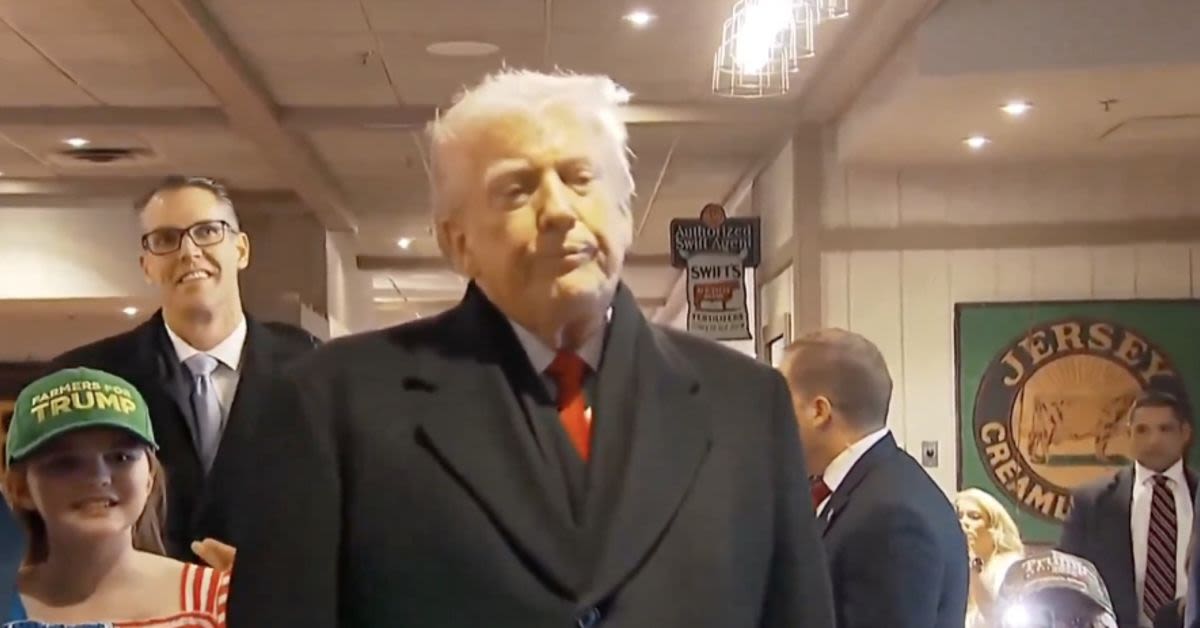
During a stop in Iowa on Tuesday, he offered a textbook demonstration of that approach, blending mockery, backhanded praise, and a pointed policy message in an exchange with an ABC Fake News reporter.
According to Western Journal, the encounter unfolded as the reporter attempted to question Trump about Alex Pretti, the 37-year-old anti-ICE agitator who was killed Saturday during an encounter with Immigration and Customs Enforcement agents in Minneapolis, Minnesota.
Some of your own administration officials have labeled Alex Pretti , the reporter began in a clip posted to the social media platform X, before Trump cut her off and seized control of the moment. By the way, this is ABC Fake News, the President said, prompting laughter from supporters gathered in the Iowa restaurant.
As the crowd reacted, Trump pressed his advantage, speaking over the noise and sharpening his critique of the network while still leaving a narrow path to civility. She hasnt asked me a good question in years, Trump added. I think a nice woman, but I dont really like her too much.
He then pivoted away, signaling that he would rather engage with another member of the press than reward ABCs line of questioning, but not before landing one more blow on the outlets credibility. Id say ABCs about as bad as they get, he said, encapsulating a long-standing conservative distrust of legacy media that many on the right view as openly hostile to their values and candidates.
In a separate video posted to X, however, Trump did address the substance of the question the ABC reporter had tried to raise, undercutting the media narrative that he had simply dodged the issue. Well, I havent heard that, the president said when asked about reports that some of his own administration officials had labeled Pretti a domestic terrorist.
From there, Trump shifted to a more sober tone, highlighting facts that much of the establishment press has been reluctant to emphasize. Certainly, he shouldnt have been carrying a gun, the president added. But all of hey look, bottom line, everybody in this room, we view that as a very unfortunate incident, everyone, unless youre a stupid person, a very, very unfortunate incident. I dont like that he had a gun. I dont like that he had two fully loaded magazines. Thats a lot of bad stuff. Despite that, I say thats very unfortunate.
By stressing the firearm and two fully loaded magazines, Trump subtly reminded viewers that Pretti was not some harmless bystander but an armed agitator inserting himself into a federal law enforcement operation. For any remaining open-minded members of ABCs audience, that detail alone should raise serious questions about what Pretti intended to do before his fatal confrontation with ICE agents.
Conservatives have long defended the Second Amendment as a safeguard of individual liberty, but they also recognize that rights come with responsibilities. Every rational person supports the constitutional right to keep and bear arms; no rational person endorses aggressively intruding into an active law enforcement operation while armed and prepared for potential violence.
Trumps handling of the exchange also reflected a pattern he first laid out decades ago in his 1987 bestseller, The Art of the Deal, where he described a strategy of playing hardball while still leaving room for respect. At the time we fought a lot, Trump wrote of then-New York City Mayor Ed Koch, and even though I ended up beating him in court, I always thought he was bright. I dont hold it against people that they have opposed me.
Seen in that light, his decision to brand ABC as Fake News while calling the reporter a nice woman fits neatly into a long-established playbook. He attacks institutions he believes are corrupt or biased, yet keeps the door open to personal reconciliation, signaling that he is willing to work with almost anyone if it advances his goals.
Above all, Trump sees himself as a dealmaker, convinced that he can turn adversaries into allies if given enough time and leverage. He appears to regard this capacity as a unique strength, and given his record of winning over former critics, it is difficult to argue that the approach has not paid dividends.
Still, what begins as a strength can, in some circumstances, edge toward a liability, especially when the other side acts in bad faith. On Monday, Trump appeared to strike a kind of understanding with Democratic Gov. Tim Walz of Minnesota, after which the President agreed to de-escalate a little bit, according to the U.K. Guardian, and Walz abruptly abandoned his combative stance toward ICE operations that had sparked anti-ICE protests, riots, and violence in the state, ordering state police at last to arrest lawbreakers.
For many of Trumps supporters, however, Walz and Democratic Minneapolis Mayor Jacob Frey are viewed not as partners but as political arsonists who enabled chaos and undermined federal authority. When Trump softens his tone toward such figures, he risks demoralizing the very base that has stood by him through relentless media attacks, lawfare, and bureaucratic resistance.
Yet Trump has been remarkably consistent in applying the philosophy he articulated four decades ago, even when it unsettles some on the right. He has filled his administration with former rivals and outspoken critics, including Vice President J.D. Vance, Secretary of State Marco Rubio, Director of National Intelligence Tulsi Gabbard, and Health and Human Services Secretary Robert F. Kennedy Jr.
Those appointments underscore his belief that winning people over is not only possible but essential to governing in a deeply divided country. Trump won them over, along with many others, and it is not inconceivable that he might one day win over that nice woman, the ABC reporter who has hasnt asked [him] a good question in years.
Whether conservatives applaud every instance of outreach or not, Trump appears determined to keep pressing his case to skeptics and opponents alike. Given his track record, and the fact that this approach has repeatedly propelled him to the pinnacle of American politics, there is little reason to expect him to abandon it now.
Login