
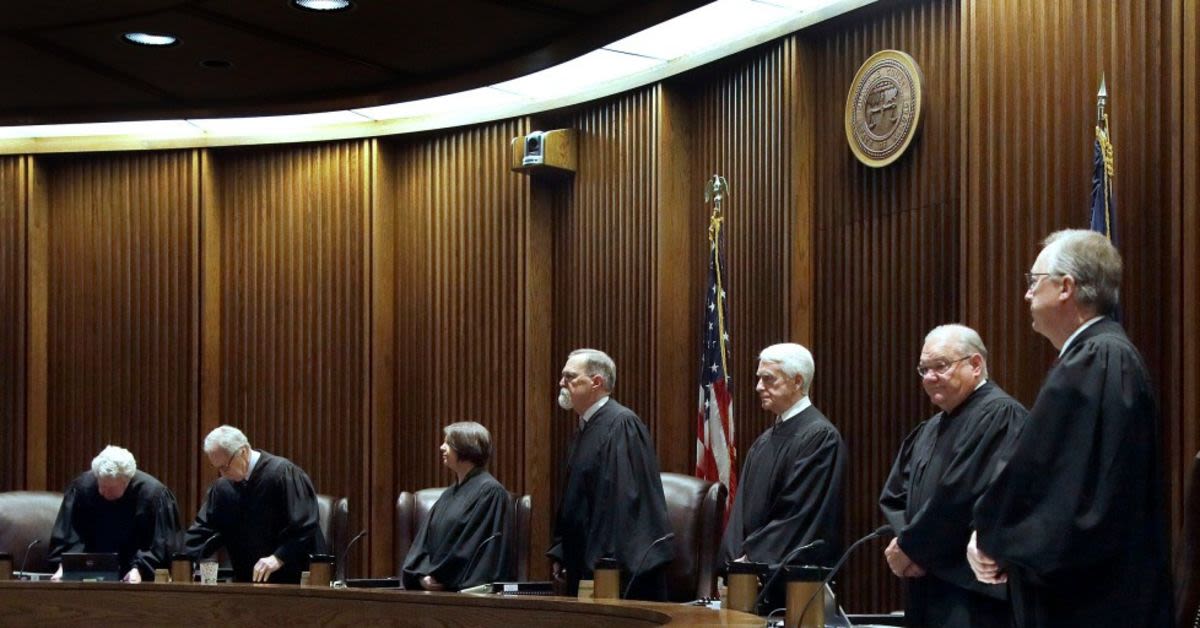
Kansas voters head to the polls Tuesday to decide whether to overhaul how their highest court is chosen, replacing the current appointment system with direct elections for state Supreme Court justices in a move long sought by conservatives frustrated with liberal-leaning rulings on abortion, school finance and capital punishment.
According to The Associated Press, the proposed constitutional amendment would fundamentally reshape judicial power in Kansas by allowing voters, rather than the governor and a lawyer-dominated commission, to determine who sits on the seven-member Supreme Court. Supporters of the measure, many of them social conservatives and pro-life advocates, hope that if it passes they can gradually elect at least four conservative, anti-abortion justices by 2033, thereby reversing what they see as years of judicial activism that has thwarted the will of the people and the Legislature.
The debate in Kansas unfolds against a national backdrop in which judicial elections have become increasingly contentious, expensive and ideological, raising questions about whether courts are becoming more partisan and less independent. In Wisconsin, for example, spending in a single state Supreme Court race last year exceeded $100 million, a staggering sum that underscores how high the stakes have become when courts are seen as the final arbiters of hot-button social issues.
Democratic Gov. Laura Kelly, who is term-limited and has used her appointment power to tilt the court to the left, has emerged as one of the most vocal opponents of the amendment. She argues that the Legislature, already distorted by partisan gerrymandering and fueled by undisclosed dark money, is out of step with the broader electorate and warns that, to think you can make the judicial branch a part of that dysfunctional system is frightening.
Republican lawmakers counter that it is precisely the courts that have become unmoored from constitutional limits and public sentiment, pointing to a series of rulings over the past two decades that they say usurped legislative authority. Their latest grievance centers on a district court judge who earlier this month reinstated a three-day grace period for mail ballots arriving after Election Day, a policy GOP legislators had explicitly repealed in an effort to tighten election procedures.
Kansas Senate President Ty Masterson, who is seeking the Republican nomination for governor and has been a driving force behind the amendment, blasted that decision as a judicial overreach. He called the ruling outrageous and urged Kansans to vote yes on the ballot question, framing the measure as a necessary check on judges who, in his view, have repeatedly substituted their own policy preferences for those of elected representatives.
The same district judge, who was recently a finalist for a vacancy on the Kansas Supreme Court, also blocked enforcement of a 2025 law banning gender-affirming medical interventions for transgender minors. Masterson has not minced words about that decision either, describing the judge as radical and citing the case as further evidence that the current selection system elevates jurists who align with progressive causes rather than with Kansas more conservative mainstream.
Republican criticism of the judiciary stretches back to a long-running battle over school finance that began in 2004, when the Supreme Court repeatedly ordered lawmakers to increase education funding to comply with the state constitution. Those rulings forced the Legislature to pour billions more into public schools, a mandate that conservatives argue has empowered unelected judges to dictate budget priorities that should be set by accountable officials.
Masterson, speaking in November to the Marion County Patriots for Liberty, a conservative grassroots group, made the stakes explicit in terms of fiscal and ideological control. If we elect our Supreme Court, they won't force you to spend money on schools, he said, according to the Marion County Record, encapsulating the conservative belief that judicial elections would curb what they see as judicially imposed tax-and-spend policies.
The push to elect justices gained fresh momentum after a 2022 statewide referendum that effectively affirmed the Kansas Supreme Courts landmark 2019 ruling that the states Bill of Rights guarantees bodily autonomy and protects access to abortion. That decision, which insulated abortion rights under the state constitution even after Roe v. Wade was overturned federally, infuriated pro-life Kansans and turned the court into a central battleground in the broader cultural conflict.
The 2022 campaign over that abortion amendment drew intense national attention and money, with total spending by both sides surpassing $12 million. Legislators who had labored to overturn the Supreme Courts abortion protections, including Masterson, then pivoted to this years proposal, seeing structural reform of the court as the only realistic path to reversing the 2019 precedent over the long term.
Just seven weeks after voters rejected the attempt to strip abortion protections from the state constitution, Kris Kobach, then a Republican candidate for attorney general and a longtime conservative stalwart, laid out the strategic logic to a GOP club in Wichita. He told activists that electing justices would slowly and quietly put anti-abortion jurists on the high court, signaling a patient, incremental approach to reshaping the judiciary rather than relying on a single, high-profile ballot fight.
The financial muscle behind the current vote-yes campaign reflects that long game, with its largest donor being a Nashville-based nonprofit that backs Republican candidates, organizations and causes nationwide. That group has poured $1.7 million into the effort, accounting for nearly half of the campaigns $3.7 million in spending and underscoring how conservatives across state lines see Kansas as a key front in the struggle over judicial power and abortion law.
Kansans for Life, the states most influential pro-life organization, has also stepped up its efforts in the final stretch, spending at least $87,000 over the past 11 days on mailers and text messages to mobilize sympathetic voters. Troy Newman, president of the national anti-abortion group Operation Rescue, framed the stakes in stark moral terms on his organizations website, declaring, Kansans can bring an end to this reign of abortion by voting yes.
On the other side, abortion-rights advocates and progressive groups are mounting a well-funded resistance, warning that judicial elections will open the door to special-interest capture of the courts and further erode protections for individual liberties. The national and state affiliates of Planned Parenthood, the countrys largest abortion provider, have contributed another $1.6 million to the vote-no campaign, which has spent more than $8 million overall to preserve the current appointment system.
Among the grassroots activists opposing the amendment is Jamie Swan, an engineer and college teaching assistant who canvassed neighborhoods in 2022 to defend abortion rights and is now knocking on doors again. I really believe that this is just a power grab, she said, arguing that the proposal is less about democratic accountability and more about enabling politicians and wealthy donors to stack the court with ideological allies.
Backers of the amendment dismiss such warnings as fearmongering and insist that giving citizens direct control over the composition of the Supreme Court is the most legitimate way to ensure judicial accountability. Globally and over history, even in its imperfection, the best system is democracy, said Elizabeth Patton, state director of Americans for Prosperity, a low-tax, small-government advocacy group that has spent $935,000 promoting the vote-yes campaign and sees the measure as consistent with its broader push to limit unelected power.
The Kansas debate is unfolding in a country where states have adopted a patchwork of methods for selecting their top judges, reflecting different philosophies about independence and accountability. Twenty-two states elect their highest courts judges, eight of them in explicitly partisan races, while governors in 26 states appoint justices and, in South Carolina and Virginia, legislators themselves choose who sits on the bench.
Kansas has experience with both models, having elected its Supreme Court justices for nearly a century before voters approved a 1958 constitutional amendment that shifted to the current merit-based appointment system. Under that arrangement, a nominating commission dominated by attorneys screens applicants and forwards three finalists to the governor, who then makes the final selection, with legislators having no formal role in the process.
A review of every states current and historical constitutions shows how unusual Kansas proposed shift would be in the modern era. The last state to adopt an amendment like the one now on the Kansas ballot was Mississippi in 1914, while since then 18 states have moved in the opposite direction, away from contested judicial elections and toward appointment or retention systems designed to insulate judges from direct political pressure.
Even under the current framework, Kansans do have a limited say over their justices through retention elections held every six years, in which voters cast a simple yes-or-no ballot on whether a sitting justice should remain on the court. Yet no justice has ever been removed through this process, a fact conservatives cite as proof that the mechanism is toothless and that jurists effectively enjoy lifetime tenure regardless of how far they stray from the constitution or public opinion.
Retirements and deaths have given Gov. Kelly outsized influence over the courts recent composition, allowing her to appoint four of the current seven justices despite her limited time left in office. Among her picks was a district court judge who, in 2023, blocked enforcement of longstanding abortion restrictions, a move that further enraged conservatives and reinforced their belief that the nominating commission and governors office are aligned with progressive legal activists.
For lawmakers like state Sen. Mike Thompson, a conservative Republican from the Kansas City area, the pattern of rulings on abortion, school funding, election law and transgender medicine all point to a judiciary that has slipped beyond the reach of ordinary Kansans. We dont have a good way to fight back, Thompson said, explaining his support for the amendment as a means of restoring what he views as a proper balance between the branches and giving voters a direct tool to correct what they see as judicial overreach.
As Election Day approaches, the clash over how to select Kansas Supreme Court justices has become a proxy for deeper disagreements about the role of courts in a constitutional republic, the meaning of democracy and the limits of majority rule on contentious social issues. For conservatives, the amendment represents an overdue correction that would return power from unelected elites to the people themselves, while opponents insist that injecting partisan campaigns and big money into judicial races will only intensify polarization and jeopardize the very rule of law the courts are meant to uphold.
Login